Annual Report
2025-2026
Year in Review
Our students come to the University of Oregon with aspirations for meaningful lives, fulfilling careers, and the opportunity to make a difference in the world. Our responsibility is to create the conditions that help every student move toward that promise, supported by the relationships, academic opportunities, and institutional structures they need to flourish.
During the 2025-26 academic year, the Division of Undergraduate Education and Student Success (UESS) strengthened the university's student success infrastructure while also taking immediate action to improve student outcomes. Guided by the University of Oregon's institutional student success priorities (outlined in the Oregon Rising strategic plan), we established our divisional vision, mission, goals, and indicators of success; expanded our use of data and evidence to guide decision making; and deepened partnerships across the university.
Using data and evidence, we focused on practices and experiences associated with retention and graduation, including early and proactive advising, targeted academic support, registration campaigns that build credit momentum, opportunities for connection and belonging, and timely financial assistance.
This year's progress reflects the collective efforts of our staff and partners across the university, grounded in a shared commitment to creating an environment where every student can succeed.
The report that follows introduces who we are, the programs and services we provide, the difference this work makes for students, and the priorities that will guide us in the year ahead.
Student Success Initiatives in Academic Year 2025-2026
- Business of Success: Enrolled incoming pre-business students with a high school GPA below 3.4 in a first-year course designed to support their academic success.
- Academic Success Coaching: Provided individualized coaching for students who earned a D grade during fall or winter term.
- Student Success Initiative: Refined proactive advising and outreach informed by predictive analytics.
- Just-in-Time Continuation Grants: Provided $60,000 to help students resolve financial holds and continue their enrollment.
- PathwayOregon Bridge Funding: Provided $325,000 to help students who lost Pell Grant eligibility remain in PathwayOregon.
- Enrollment Calling Campaigns: Reached out to students who had not registered to offer support, help resolve holds, and better understand barriers to continued enrollment.
- Provost Undergraduate Research Assistantship: Created a new opportunity for high-achieving incoming students to begin faculty-mentored research during their first year. The inaugural cohort of 55 students begins in fall 2026.
Who We Are
Vision
We envision a University of Oregon where every undergraduate is known, supported, and able to flourish here and beyond—and where student success is a defining institutional strength.
Mission
UESS supports undergraduate success through care for individual students, courageous leadership, and partnership with the University community. We cultivate the conditions that expand opportunity and support success for every student.
Values
- Student-Centered: We prioritize students in everything we do.
- Collaboration: We advance our work through shared purpose and partnership.
- Equity: We act for equity.
- Impact: We focus our time, effort, and resources to make a difference.
- Growth: We are reflective, adaptive, and innovative.
Divisional Goals
We measure our success by our ability to create the conditions for every admitted student to persist, graduate, and flourish. UESS provides institution-wide leadership, expertise, and coordination in key student success domains. These goals reflect our responsibility to design, deliver, and coordinate supports that meet the needs of the students we admit—providing structure, connection, and timely support at human scale.
Goal 1: Create a sense of connection and belonging for students.
Ensure students feel known, connected, and supported through relationships that build belonging, engagement, and confidence.
Goal 2: Provide universal and proactive academic support.
Provide academic support for all students by default, with timely, targeted support aligned to student needs, so students do not need to see help on their own.
Goal 3: Remove structural and systemic barriers to student persistence.
Identify and change institutional policies, practices, and systems that make it harder for students to enroll, stay enrolled, or make academic progress.
Goal 4: Build early and sustained academic momentum toward timely graduation.
Design onboarding, advising, curricular pathways, and transition structures that help students make early progress, anticipate common roadblocks, and stay on track to graduate.
Goal 5: Expand access to high-impact experiences.
Increase equitable access to high-impact experiences that deepen learning, support achievement, and strengthen career and post-graduation success.
Goal 6: Use data and evidence to drive continuous improvement.
Use timely, shared data and evidence to identify risk early, guide coordinated decision-making, and continuously improve student success strategies and outcomes across the university.
What We Do
UESS offers a variety of programs and services for students.
Accessibility
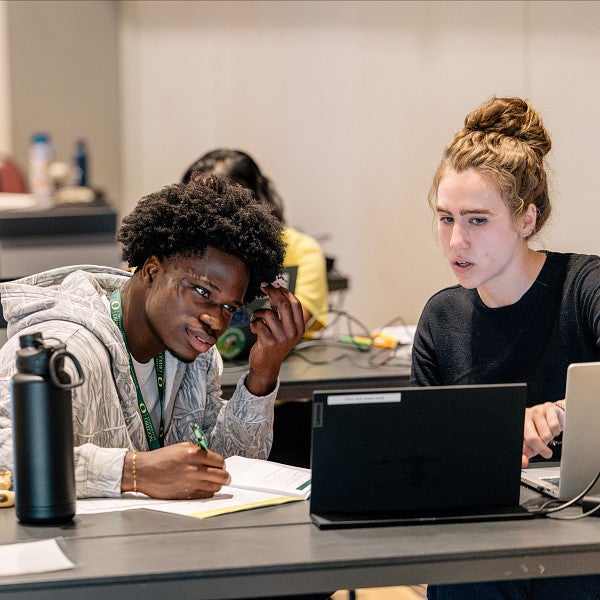
The Accessible Education Center facilitates access and inclusion for students with disabilities and removes barriers to success.
Services: Disability-related accommodations; access advising; academic support outreach, consultation, and advocacy; campus-wide trainings; and campus programming to support community-building and disability inclusion.
Advising
Our advising teams help students build momentum toward graduation through personalized support and coordinated advising practices that connect students to the right support at the right time.
Programs: Exploring Advising, Transfer Advising, TRIO Student Support Services, PathwayOregon, Center for Multicultural Academic Excellence, and Office of Academic Advising.
Data and Assessment
Our data and assessment team uses evidence to drive continuous improvement for our units, the division, and for the university.
Services: Assessment and evaluation, data analysis and reporting, and evidence-based decision support.
First-Year Programs
First-year programs make students' transitions to the UO seamless, substantial, and rewarding. Students build connections with peers and faculty members while engaging in academic curriculum.
Programs: First-Year Interest Groups, First-Year Seminars, First-Year Communities, Academic Residential Communities, Residential Communities, Faculty-in-Residence, and Faculty in the Halls.
Pre-College Programs
Our pre-college programs provide immersive college experiences for Oregon high school students, inspiring them to pursue higher education.
Programs: Student Academy to Inspire Learning and Oregon Young Scholars.
Tutoring and Academic Support
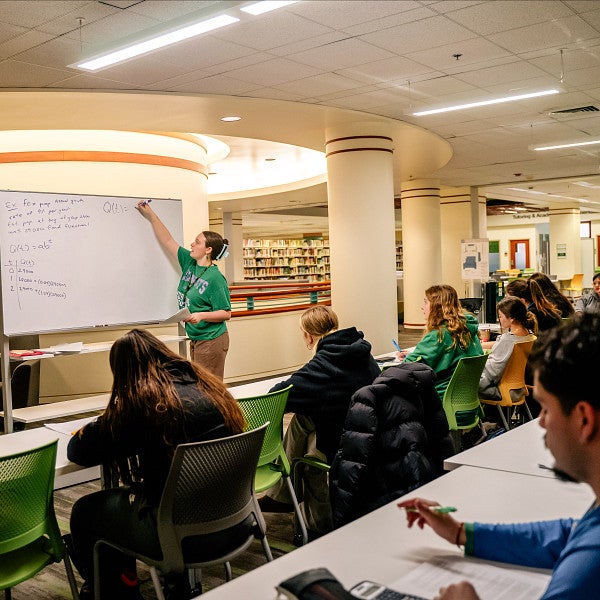
The Tutoring and Academic Engagement Center provides resources and services for students who want to enhance their learning and academic performance.
Services: Math, writing, and Spanish tutoring; Class Encore study groups; academic coaching; and study skills courses.
Undergraduate Research and Distinguished Scholarships
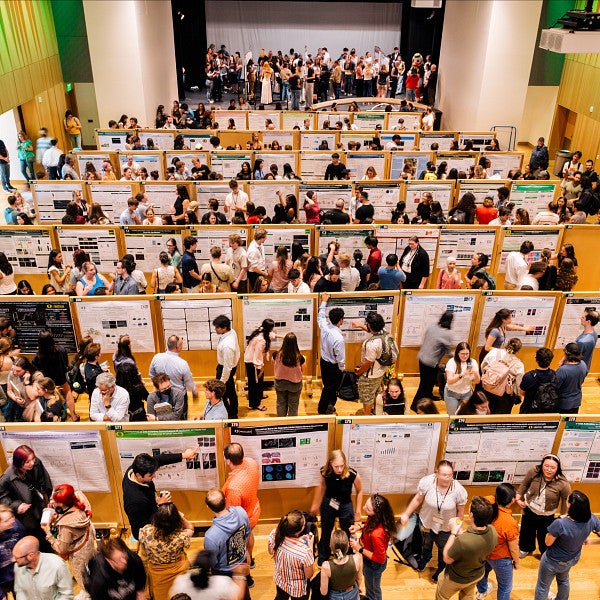
Through mentorship and advising, we expand access to undergraduate research, distinguished scholarships, post-graduate fellowships, and experiential opportunities.
Programs: Center for Undergraduate Research and Engagement, Office of Distinguished Scholarships, TRIO McNair Scholars Program, Alpha of Oregon Chapter of Phi Beta Kappa, Provost Undergraduate Research Assistantship, and Undergraduate Research Symposium.
Why It Matters
Transforming Students' Lives
First and foremost, everything that we do has a real impact on students and their lives, and that is what matters most.
I was completely validated in my experience struggling to complete work on my own. We came up with a plan that actually made me excited to complete my work. I have never felt that way or so confident in myself that I also belong in an academic environment.
Had I not received this funding, I wouldn't have been able to attend the conference adn I would have missed a vital opportunity to conduct research and to network wtih the professionals working in my field.
As a first-generation student, Pathway allowed me not only to attend college but to fully take advantage of opportunities.
I thought that college would never be possible for me coming from a low-income family. I feel like I have options now.

Creating Lasting Impact
Student success creates measurable value for students, the university, and society. According to the National Institute for Success (NISS) in a 2026 report compiled for the University of Oregon:
- Students with a college degree, on average, earn about 50 percent more than those with only a high school diploma, have more life choices, have better access to health care, maintain longer life expectancies, and offer their children better access to healthcare and education. They are also almost three times more likely than students with only some college to pay off their college loan debt.
- Every 100 additional degree-seeking students that UO retains generates roughly $1.6M in additional tuition and fee revenues annually. Each 100 additional students who stay enrolled at UO through graduation rather than dropping out in the first year generate almost $4.8M in additional tuition and fee revenues.
- Individuals holding college degrees will earn $900K more over the course of their careers when compared to individuals having only a high-school diploma. Each 100 additional UO graduates will contribute $90 million more to the state, their communities, and businesses over their lifetimes.
Source: Pew Research Center and OneClass cited in Renick, Timothy M. 2026. "NISS Diagnostic and Playbook Prepared for the University of Oregon." National Institute for Student Success, 55.
Building the University's Future
Collectively our work supports the University of Oregon's ambitious goals to enhance pathways to timely graduate for all undergraduate students. The Oregon Rising strategic plan sets targets of 70% four-year graduation, 85% six-year graduation, and no equity gaps.
Reaching these targets starts with what students experience in the first year. Right now, 14% do not make it to their second year. Data from across the country shows that we need to reach 94% first-year retention to meet our graduation targets. This is a significant challenge. Affordability and differences in incoming academic preparation shape student outcomes in meaningful ways. Addressing those structural factors requires long-term, sustained effort. At the same time, we have a responsibility to strengthen how the university supports every student we admit.
Oregon Rising identifies strategic areas where progress is expected to improve future retention and graduation outcomes:
- First-Year Advising: Students who see an advisor early in their academic career have better retention outcomes.
- Credit Momentum: Students who take 45+ credits during their first year are substantially more likely to graduate in four years.
- First-Year Experience: First-year experiences build belonging, connection, and skills that help students flourish and succeed academically.
- Grade Outcomes: Early intervention and support for students who struggle academically—receiving a D, F, or W grade—can help students rebound and persist.
UESS provides the services and support that make a difference in these areas. In addition to the core support services that we provide to all undergraduates, we launched several initiatives to support students early in their academic journey, understanding that first-year retention is critical to long-term success.
Delivering Measurable Results
The analysis of our impact that follows focuses primarily on first-time, full-time (FTFT) undergraduate students, whose first-year outcomes provide important early indicators of progress.
At a high level, what we found was:
- Wide Reach: Nearly 70% of all first-year students engaged with UESS programs or services, demonstrating broad institutional reach.
- Equity Enhancement: UESS is reaching students most likely to benefit from support, including students who have disabilities, receive Pell Grant funding, are first-generation, or who are Native American, Black, Latino/a/x, or Pacific Islander.
- Effective Targeted Support: Targeted academic support shows especially strong results for students facing academic and financial barriers.
- Early Retention Increases: Students with multiple UESS connections demonstrated the highest persistence rates, suggesting that coordinated support networks matter.
Moving the Needle on Retention
Short-term retention increases if students engage with UESS programs and services. For example, PathwayOregon is closing the equity gap for Pell Grant eligible students, as their students persist at higher rates than their peers.
FTFT Fall-to-Spring Retention
FTFT Fall-to-Fall Retention
Our Reach
Who We Serve
Of the FTFT Students Who Engaged With 2+ Programs:
Meeting Rising Support Needs
The Accessible Education Center Received:
(a 98% Increase From Three Years Prior)
Academic Year | Students Registered with the Accessible Education Center |
|---|---|
AY15 | 1,250 |
AY20 | 1,958 |
AY25 | 3,763 |
Our Impact
Connecting Students With Advising
Almost every student with connections to UESS's programs met with an advisor in their first year, and most had by the end of fall term.
Engagement with UESS | Fall Advising Rates |
|---|---|
2+ Engagements | 83.6% |
1 Engagement | 67.7% |
No Engagement | 53.6% |
Driving Academic Recovery
Students who showed early academic struggles in their first fall term (earning a D, F, or W grade) had substantially higher fall-to-spring retention if they engaged with the Tutoring and Academic Engagement Center.
Engagement with TAEC? | Fall-to-Spring Retention |
|---|---|
No | 82% |
Yes | 94% |
Building Credit Momentum
Of FTFT students who engaged with 2+ UESS programs:
Funding Students in Need
Launching New Initiatives for Student Success
Guided by recommendations from NISS and emerging evidence from our own assessment efforts, UESS will launch several new initiatives designed to improve persistence, belonging, and timely graduation.
- First-Year Advising Initiative: Six new advisors embedded within schools and colleges will provide proactive, targeted support to first-year students who may benefit from additional academic support. This initiative reflects growing evidence that early advising contact is an important contributor to student success.
- Provost Undergraduate Research Assistantship: PURA will connect 55 high-achieving students with early research opportunities in its inaugural year.
- Stop-Out Tracking and Early Intervention: We will use engagement indicators, including Canvas participation and other institutional data, to identify students who may be disengaging from their academic experience. These efforts will be paired with proactive outreach and support before those barriers disrupt students' academic progress.
- Faculty Early Alert Initiative: As part of our early intervention efforts, we are launching a new faculty referral and outreach process that will focus on courses that serve large numbers of first-year students, helping connect students to resources and support at the earliest signs of academic difficulty.
- First-Year Experience Redesign: UESS and campus partners will redesign the first-year experience to ensure every student meets key milestones that support belonging, engagement, and academic success.
- Summer Bridge Program: UESS will explore a new for-credit summer bridge experience designed to help incoming students build academic momentum, earn credits before the start of fall term, and establish meaningful connections with peers, faculty, and staff.
- Academic Support Alignment: Tutoring, peer study groups, and other academic support resources will be increasingly aligned with courses that have historically high DFW grade outcomes, ensuring support is available where students need it most.
- Accessibility and Student Accommodations: UESS will continue expanding capacity to meet growing demand for accommodations, testing services, and other accessibility supports that reduce barriers to student success.
- Redesign of Completion and Continuation Grants: Guided by NISS recommendations and institutional data, UESS will refine financial support programs to maximize their impact on student persistence and graduation outcomes.

Looking Forward
As we begin a new year, our division remains focused on our long-term goals: fostering belonging and connection, providing proactive academic support, removing barriers to persistence, building academic momentum toward timely graduation, expanding access to high-impact experiences, and using data and evidence to drive continuous improvement.
As part of our commitment to continuous improvement, we partnered last year with the National Institute for Student Success (NISS) to develop a diagnostic and student success playbook for the University of Oregon. Their recommendations affirmed many of the strategies and initiatives already underway while challenging us to do more in key areas such as redesigning the first-year experience for all students, continuing to strengthen our data infrastructure, strengthening advising across the university, and providing targeted, proactive financial support to students.
Building on this work, we will continue investing in both the foundational services and emerging strategies that support student success. Advising, accessibility services, tutoring and academic support, first-year programs, and undergraduate research opportunities remain at the heart of our mission and continue to make a meaningful difference in students' lives. At the same time, we are committed to testing, refining, and scaling new approaches that show promise, using data and evidence to guide our decisions and improve outcomes for students.
If we want to be the university our students believe us to be, we must ensure that every learner who begins their journey here has a fair chance to finish it. We are committed to changing for the better and to doing the deep, enduring work that makes those changes real.
Just as important as launching new initiatives is understanding whether they are making a difference. In the coming year, UESS will continue evaluating both new interventions and core services to better understand what works, for whom, and under what circumstances. Through assessment, reporting, and continuous improvement, we will use evidence to guide decisions, scale effective practices, and ensure resources are directed where they can have the greatest impact.
Together with our partners across the university, we are creating the conditions for every admitted student to succeed. While many of the challenges affecting student success are complex and long-term, we remain committed to doing more of what matters most: strengthening belonging, supporting academic momentum, removing barriers to persistence, and helping every student discover a clear path to graduation and a flourishing future.